

Share


-
 Author - Alana Jones
-
 Read Time -
10 mins
-
 Date - 06 August 2026
Should your online store invest in SEO or PPC? Get this wrong and you can waste thousands of pounds in marketing budget chasing the wrong channel for where your business actually is right now.
Ecommerce SEO vs PPC is the fork in the road every UK online store hits eventually: put the budget into organic rankings that build over time, or put it into paid ads that bring traffic starting today? This guide compares both properly so you can decide where to invest first — and, more importantly, how to combine them as your store grows.
| At a glance | Ecommerce SEO | PPC |
|---|---|---|
| Speed | Long-term | Immediate |
| Traffic type | Organic | Paid |
| Cost over time | Falls the longer it runs | Constant, ongoing spend |
| What it builds | Authority and rankings you own | Visibility and promotions you rent |
Most guides frame this as a choice you have to make once and stick with. In practice, the strongest UK ecommerce stores don’t pick a side — they run both, in a mix that shifts as the business matures. That’s the framing this guide uses throughout, and the budget tables further down show what that mix actually looks like at each stage.
Key takeaways
- Online sales make up around 27–30% of total UK retail spend, according to the ONS Retail Sales Index — a huge share of revenue is decided entirely on a search results page.
- Ecommerce SEO typically needs 4–9 months before ranking movement is visible, but cost per sale drops the longer it runs.
- PPC for ecommerce can generate sales within hours of launch, but cost per click rarely falls on its own.
- Retargeting campaigns usually convert 3–5x better than cold PPC traffic, because that audience already knows the brand.
- Most UK stores that scale well run SEO and PPC together, not one instead of the other.
What ecommerce SEO actually covers
Ecommerce SEO means optimising an online store — product pages, category pages, blog content, and the technical structure underneath — so it ranks in Google without paying per click. A store isn’t a simple five-page website; it can have thousands of product, category, and filter pages, and all of them affect how the whole domain ranks.
| SEO pillar | What it does for your store |
|---|---|
| Technical foundation | Page speed, mobile experience, crawlability, sitemap health, HTTPS setup |
| On-page optimisation | Product titles, meta descriptions, keyword placement, image alt text |
| Content strategy | Buying guides, comparisons, category copy, FAQs for early-stage research |
| Authority building | Backlinks, brand mentions, review signals, domain trust |
| Store architecture | Clean category hierarchy, tidy URLs, internal linking between pages |
| Rich results | Schema markup for price, stock status, and star ratings |
Get all six working together and the outcome is simple: more of the right traffic, not just more traffic.
Product pages carry the weight
Product pages are where the revenue actually happens, and they’re usually the most neglected part of a store. A page that’s doing its job has:
- A unique title built around what people actually search, not the manufacturer’s default copy
- A description that’s genuinely useful, not a rewritten spec sheet
- Proper images with descriptive alt text
- Schema markup showing price, stock, and reviews
- Real customer reviews — good for conversion and for fresh content signals
- Internal links to related products and categories
Fix these and you improve rankings and on-page conversion rate at the same time — it’s the highest-leverage part of any ecommerce SEO plan.
Store structure and internal links
Google favours stores that are easy to navigate — for crawlers and shoppers alike. The structure that consistently works is:
Homepage → Category → Subcategory → Product
That hierarchy makes crawling more efficient, spreads authority through the site properly, and keeps browsing frictionless, which lowers bounce rate and lifts conversions together.
Internal linking sits on top of that structure — category pages linking to bestsellers, product pages linking to related items, blog posts linking to the products they mention. It tells Google how pages relate to each other, and it speeds up rankings across the whole catalogue, not just one page at a time.
Rich results and structured data
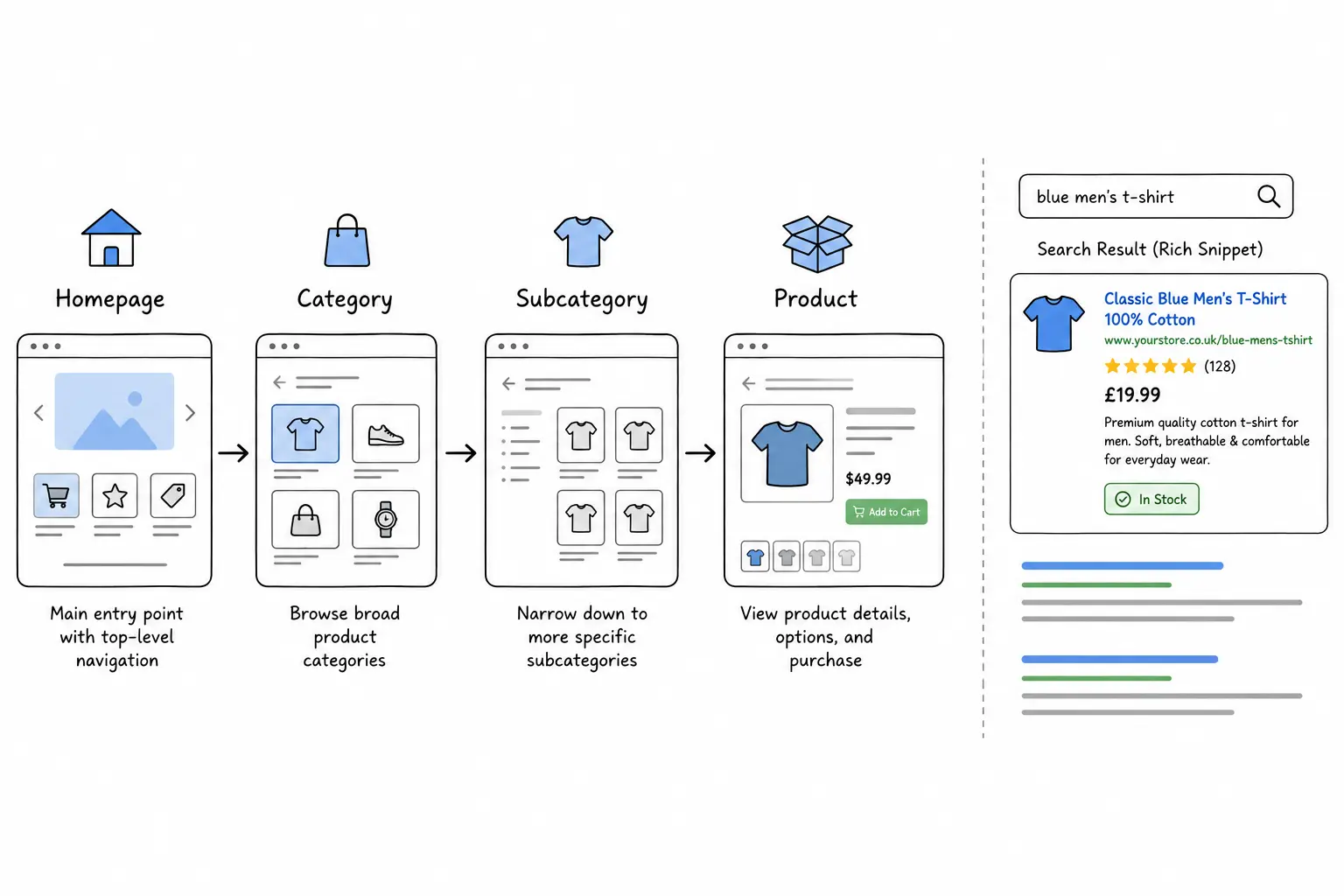
Schema gives Google structured, machine-readable information about your products — price, stock, star ratings, review counts. Done properly, it produces rich snippets in search results (the stars and price tags under some listings), which pull noticeably higher click-through rates than a plain blue link. If you want the fuller picture on how AI-driven search is changing what “ranking” even means now, our AI SEO guide covers that in depth.
How long ecommerce SEO actually takes
| Stage | What’s actually happening |
|---|---|
| First 90 days | Technical fixes, keyword mapping, foundational content, indexing clean-up — unglamorous but everything else depends on it |
| Month 3 to 6 | Early ranking shifts, organic traffic starts trending up, impressions climb |
| Month 6 to 12 | Revenue growth accelerates, cost per acquisition drops, domain authority strengthens |
The work done in month one is still earning in year three. That’s the part PPC simply can’t replicate.
What it costs in the UK
| Store size | SEO spend/month | PPC spend/month |
|---|---|---|
| Small store | £800–£2,500 | £500–£3,000 |
| Growing brand | £2,500–£6,000 | £3,000–£12,000 |
| Established/enterprise | £8,000+ | £12,000–£80,000+ |
What PPC for ecommerce actually covers
PPC — Google Search Ads, Google Shopping, Meta and Instagram Ads, retargeting — means buying placement directly instead of earning it through optimisation. You pay the platform for a spot, and again every time someone clicks.
For a store that needs revenue fast — a launch, a seasonal window, a market test — PPC is the quickest route to traffic there is. Increasingly, that also means automated campaign management; our piece on agentic AI in PPC covers how UK advertisers are handling that shift.
| Format | Where it earns its keep |
|---|---|
| Google Shopping | High-intent shoppers ready to buy — product image, price and store name shown directly in results |
| Search Ads (text) | Specific keyword targeting, including competitor brand terms |
| Meta/Instagram | Visual discovery, catching people before they’re actively searching |
| Retargeting | Re-engaging site visitors and basket abandoners — usually the strongest-converting format available |
| Display | Top-of-funnel awareness across Google’s ad network |
The auction, briefly
PPC runs on competitive bidding — placement depends on keyword relevance, bid amount, quality score, and landing page quality. Unlike SEO, traffic can start within hours of going live.
The trade-off is structural: every visitor has a cost attached, permanently. There’s no version of PPC where traffic eventually becomes free. Pause the spend, the traffic stops the same day.
The metrics worth actually watching
| Metric | What it tells you | Watch for |
|---|---|---|
| CPC | Cost per click | Rising CPC on flat conversion rate = shrinking margin |
| CTR | Click-through rate | Low CTR usually means weak ad relevance, not a targeting problem |
| CPA | Cost per acquisition | The number that actually decides profitability |
| ROAS | Return on ad spend | Needs to be read against margin, not in isolation |
| Conversion rate | % of visitors who buy | A landing page problem, not an ad problem, most of the time |
Most profitable UK stores target at least 3:1 ROAS. Higher-margin categories (beauty, supplements) can stay healthy closer to 2.5:1; thin-margin categories (electronics, commodities) often need 4:1+. Retargeting regularly beats all of this, landing 5:1–8:1.
PPC timeline
| Window | What happens |
|---|---|
| Days 1–3 | Campaigns go live, first impressions and clicks land |
| Weeks 1–4 | Enough data builds up to make real optimisation calls |
| Months 1–3 | Campaigns mature enough for proper A/B testing |
| Ongoing | Management never really stops — this is the part people underestimate |
Minimum workable budget sits around £1,200–£2,500/month — below that, there isn’t enough data to optimise meaningfully. Average CPC ranges from roughly £0.40 in low-competition niches to £4–£12+ in fashion and electronics.
Which keywords belong to SEO, and which belong to PPC?
A lot of wasted budget comes down to targeting the wrong keyword with the wrong channel. Not every search term deserves the same treatment — where it sits in the buying journey usually decides whether SEO or PPC will do more with it.
| Keyword type | Example | Works best with | Why |
|---|---|---|---|
| Informational | “how to choose running shoes” | SEO | People aren’t ready to buy — paying per click here rarely pays for itself |
| Commercial | “best running shoes for flat feet” | SEO + PPC | Comparison-stage searches convert reasonably in both, so it’s worth testing which wins for your store |
| Transactional | “buy Nike Pegasus 41 UK” | PPC (with SEO backup) | High intent, high competition — PPC guarantees the spot while SEO catches up over time |
| Branded | “[your store name] running shoes” | SEO | You should already own this organically; paying for your own brand traffic is usually wasted spend |
A simple rule that holds up in practice: let SEO do the heavy lifting on informational and branded terms, and reserve PPC budget for transactional terms where competitors would otherwise take the sale while you’re still climbing the rankings.
Ecommerce SEO vs PPC: the comparison that matters
| What you’re weighing | Ecommerce SEO | PPC |
|---|---|---|
| Time before you see anything | 4–9 months | Hours to days |
| Where the traffic comes from | Earned, organic | Bought, per click |
| Cost direction over time | Trends down | Flat, often trends up |
| What happens if you stop | Traffic mostly persists | Traffic stops the same day |
| Risk if the channel underperforms | Sunk cost, but the asset (content, rankings) still has some value | Sunk cost with nothing left over |
| Reporting complexity | Slower signals, needs patience to read correctly | Real-time, easy to over-react to noise |
| Typical break-even point | 6–12 months | 1–3 months (if margins support it) |
| How shoppers perceive it | Feels earned, more trusted | Clearly labelled as paid |
| Ceiling on growth | High — grows with content and authority | Capped by budget and rising CPCs |
Where the ROI actually flips
Here’s the financial reality: SEO and PPC essentially swap ROI profiles over time. In the first six months, PPC usually wins — it’s producing revenue while SEO is still doing groundwork. Somewhere between months six and eighteen, that flips. Organic traffic has no per-click cost, so as rankings strengthen, cost per acquisition keeps falling, while PPC’s CPA tends to stay flat or climb as more advertisers bid on the same terms.
A simpler way to think about it: PPC is like renting a billboard — visible immediately, gone the moment you stop paying. Ecommerce SEO is like planting a garden — nothing for a while, then it starts producing on its own, and it keeps producing with far less upkeep than you’d expect. Early-stage stores often need the billboard for cash flow. Growth-stage brands shift toward the garden to stop being dependent on rent.
Which traffic actually converts better
Organic traffic tends to convert higher than paid, for a fairly simple reason — people who find a store through organic search went looking for it themselves. There’s an implicit trust in an organic listing a labelled ad doesn’t get in the same way. Paid traffic quality swings a lot based on targeting and creative — retargeting is the clear exception, converting 3–5x better than cold traffic because that audience already knows the brand.
How each one scales
Ecommerce SEO scales through content — more product pages, more category coverage, growing keyword footprint and domain authority. Each new page adds to the asset without a matching cost increase.
PPC scales through budget, and that hits two ceilings fast: CPCs climb as spend increases because you’re bidding for more competitive slots, and audience saturation eventually caps returns. Going from £5,000 to £50,000/month in ad spend rarely produces a 10x revenue jump — the maths doesn’t hold at that scale.
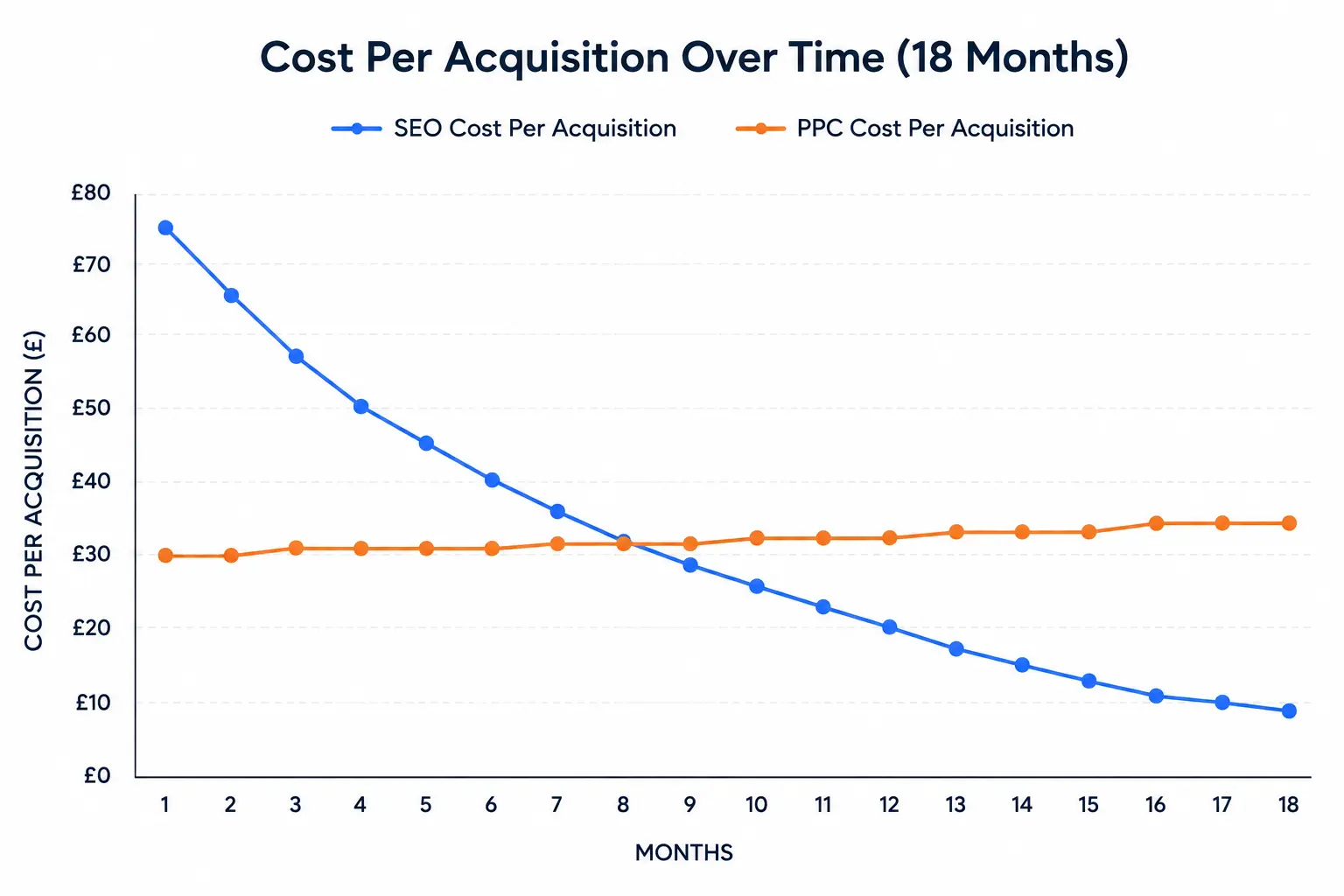
Ecommerce SEO vs PPC: Where Should Your Next Pound Actually Go?
Every UK online store hits this fork in the road eventually — chase fast sales through paid ads, or build traffic that keeps working long after you stop paying for it. The right answer depends less on which channel is “better” and more on where your business stands today.
How this plays out for different types of stores
The theory only means so much until you see it against a real category. Here’s how the ecommerce SEO vs PPC mix tends to shift depending on what you sell.
Fashion store. High visual appeal, impulse-driven, short trend cycles. Meta and Instagram PPC usually outperforms here because people discover products before they search for them. SEO still matters for evergreen terms (“men’s linen shirts UK”), but paid social typically carries more of the early-stage weight.
Electronics store. Longer research phase, higher price points, more comparison shopping. Buyers Google spec comparisons and reviews before purchasing, which plays directly into SEO’s strengths — informational and commercial content earns trust well before the transactional search happens. Google Shopping Ads still matter for capturing the final “buy now” moment.
Furniture store. Big-ticket, considered purchases with long decision cycles and heavy retargeting potential. Someone browsing a sofa today might not buy for three weeks — retargeting ads bring them back, while SEO-driven buying guides (“how to choose a sofa for small rooms”) build the trust that closes the sale later.
Local ecommerce brand (ships nationally but has a UK hometown identity). Local SEO signals — location-specific landing pages, “made in [city]” content, Google Business Profile if there’s any physical presence — combine well with branded PPC to defend against larger competitors bidding on the brand name. This is usually the leanest budget of the four, so hybrid spend needs to work harder.
[IMAGE PROMPT 5 — Four small icon illustrations in a row representing a clothing rail (fashion), a laptop/phone (electronics), a sofa (furniture), and a UK map pin with a shop icon (local ecommerce). Flat, consistent brand-coloured style, simple line icons.]
A simple decision framework
If the tables above feel like a lot to weigh up, it usually comes down to three questions, in this order:
1. Do you need sales in the next 1–2 weeks?
Yes → Start with PPC. No → Move to question 2.
2. Can your budget absorb 4–6 months before SEO pays off?
Yes → Prioritise ecommerce SEO. No → PPC needs to carry the business for now, with SEO started in the background regardless.
3. Do you need both fast revenue and a long-term asset?
Yes (most stores) → Run a hybrid strategy — split budget per the stage table below, and let PPC data inform your SEO content as you go.
Ready to stop guessing and start growing?
Which one should you actually pick?
| Your situation | Lean toward |
|---|---|
| Building for the next 1–3 years, margins can absorb a quiet start | Ecommerce SEO |
| New store, near-zero domain authority, need sales this month | PPC |
| Launching a product or running a short seasonal window | PPC |
| Competitive niche where CPC is eating your margin | Ecommerce SEO |
| You want to stop renting traffic and start owning it | Ecommerce SEO |
| You need fast answers on messaging, pricing, or product-market fit | PPC |
| You have even a modest budget to split across both | Hybrid — almost always the strongest option |
Budget by business stage: startups vs established ecommerce brands
| Stage | Suggested split | Why |
|---|---|---|
| New (0–12 months) | 25% SEO / 75% PPC | No organic authority yet — PPC has to carry revenue while SEO builds a foundation |
| Growth (1–3 years) | 50% SEO / 50% PPC | Rankings starting to contribute — balance speed against building the asset |
| Established (3+ years) | 65% SEO / 35% PPC | Organic equity should be carrying most of the load by now |
Fashion and lifestyle stores tend to see stronger returns from social PPC. Electronics, B2B, and higher-consideration purchases usually get more from organic search and Shopping ads.
Where stores actually lose money
Pulling the plug on SEO too early. Quitting after two or three months because rankings haven’t moved is the single most common mistake we see. SEO runs on a 6–12 month horizon — stopping in month three means giving up right before the payoff starts. Run PPC alongside it so revenue doesn’t stall while the foundation builds.
Building the whole store on rented traffic. A business that’s 100% PPC-dependent is fragile — any budget disruption halts acquisition instantly, and rising CPCs quietly erode margin. Build SEO in parallel so you’re not permanently paying rent.
Doing SEO badly rather than not doing it. Targeting keywords with zero purchase intent, thin product descriptions, no schema, duplicate filter pages cannibalising rankings — this is worse than doing nothing because it looks like progress while quietly wasting budget. Start with a proper audit before writing content.
Sending traffic to a page that leaks customers. Great rankings or a strong CTR mean nothing if the product page or checkout process loses people. Fix conversion rate before you scale traffic to either channel.
Watching the wrong numbers. Impressions and keyword positions that don’t tie back to revenue are a distraction. CPA, ROAS, revenue per organic visitor, and lifetime value are what actually matter.
Treating SEO as a Q4-only afterthought. Piling everything into paid ads for the busy season while ignoring SEO the rest of the year means starting from zero every peak period. Keep SEO running year-round so peak season amplifies existing authority instead of building from scratch.
A working roadmap
| Phase | Focus | What you should see |
|---|---|---|
| Weeks 1–4 | Technical audit, keyword mapping, launch PPC, set up tracking properly | Crawl issues fixed, campaigns live, clean baseline data |
| Month 2–3 | Product and category content, first PPC optimisation pass, CRO fixes | Early impressions climbing, PPC ROAS stabilising |
| Month 4–5 | Backlink outreach, expand content into buying guides, scale winning ad sets | Rankings improving on target terms, blended CPA starting to fall |
| Month 6+ | Competitive gap analysis, content expansion, reassess budget split | Organic revenue accelerating, less reliance on paid spend |
Final Thoughts
Ecommerce SEO and PPC aren’t rivals — they’re tools for different jobs. PPC gets you speed and fast validation. Ecommerce SEO gets you sustainability and a cost per acquisition that goes down instead of up. The stores that win long-term aren’t the ones that picked a side — they’re the ones that used both, deliberately, based on where the business actually was at each stage.
If you’re building something that still needs to work in three years without your ad budget growing every one of them, ecommerce SEO services are where that starts. Need revenue moving this month? PPC campaigns for ecommerce get there fastest. Most stores we work with run both — organic search work compounding quietly in the background while ads cover the gap.
Not sure where your next pound should go? That’s worth a short conversation, not a guess.
Frequently Asked Questions
Ecommerce SEO vs. paid ads: which is better?

Neither on its own. In the “ecommerce SEO vs PPC” debate, SEO builds cheaper, compounding traffic over time, while PPC gets you visible today.
How long does eCommerce SEO take to show results?
Most stores see initial movement within 3–4 months, and measurable revenue impact between months 6–9. Competitive categories with entrenched players take longer.
What's a good ROAS for UK ecommerce PPC?
Minimum 3:1 as a baseline. High-margin categories can hold at 2.5:1; thin-margin categories often need 4:1+. Retargeting usually performs best, often 5:1–8:1.
Should a brand-new store focus on SEO or PPC first?
Both, in parallel — PPC covers revenue while the domain has no authority, and SEO should start immediately so the store isn’t permanently dependent on ad spend.
Can SEO and PPC actually work together, or is that just theory?
It works in practice. PPC data shows which products and keywords convert, which then guides SEO content — and a stronger organic presence tends to lift PPC performance too.
Will a Google algorithm update wipe out my rankings?
Updates affect every site, but impact correlates with SEO quality — thin content and manipulative link profiles are most exposed. Strong technical foundations and genuine content weather updates better, and running PPC alongside SEO reduces the risk of one update tanking all your traffic. It’s also worth understanding how AI search platforms like ChatGPT are changing visibility beyond traditional Google rankings.
Is it too late to start ecommerce SEO in a competitive niche?
No, but it takes more patience than a few years ago, since established competitors have had time to build authority. Long-tail product keywords and genuinely useful content still deliver strong results, even on newer domains.


